and let’s take a moment to appreciate the fact that michelangelo had probably never seen a girl naked and when he want to sculpt or paint them his mentality seems to be “wow, everyone likes women….they must be like…..buff dudes. i love buff dudes. women are buff dudes but with little chest lumps and no wiener”
☿ Intersex oppression can be called intersexism, perisexism, dyadism, intersexphobia, intersexmisia, intersex antagonism, or anti-intersex bigotry. The most common terms, however, are intersexism and dyadism.
☿ Hermaphrodite as a term saw several decades of positive self-descriptive use among intersex people. It has since been used as a slur, with such overwhelming success that many intersex people hate hearing the word. However, plenty of older intersex folks still use it.
☿ Non-intersex people are known as “dyadic” or “perisex” people. It is entirely possible for any perisex person, even a very very queer one, to uphold perisexist norms that harm intersex people.
☿ Intersex genital mutilation is a huge problem, both inside and outside the US. In the US, intersex genital mutilation is still completely legal.
☿ Most intersex people and organizations, as well as most LGBTQIAPN+ organizations, acknowledge the shared history and oppressions of intersex people and the greater queer community and include the letter “I” to invite us to participate in what has historically been our home.
☿ Some intersex people do not wish to be considered LGBT+ for being intersex, preferring to think of their intersex status as a medical condition, with more in common with disability activism than gender activism. These people, however, should never be used as “proof” that intersex people are ”not really queer.”
☿ While intersex people can identify as cisgender, and by extension identify as cishet, it is generally accepted that intersex people are not protected by or prioritized under cisheteronormativity. For this reason, many intersex activists prefer the use of “ipsogender” rather than “cisgender” to refer to intersex people who continue to identify with their forced gender assignment.
☿ Gender and sexual normativity are the root cause of almost all the violence that intersex people face, both medically and socially.
☿ Intersex people often use Mercury’s astrological symbol to refer to our gender, similar to the use of the venus symbol for women, and the mars symbol for men. Rarely, intersex people use the astrological symbol for earth instead.
☿ There are two popular intersex flags. The more widely accepted flag was designed by an intersex advocacy organization in Australia, for global use by the entire intersex population. It is a yellow field with a centered purple ring. Less commonly, a flag based on the more common trans flag is used, featuring six stripes: purple, white, blue, pink, white and purple. The blue and pink stripes are blended into a blue-pink gradient.
☿ The white stripe in the trans flag is for transitioning, nonbinary, genderless and intersex people. The separation of the intersex and trans community is very novel. As late as 2000, when the trans flag was popularized, intersex people were considered part of the trans community.
For pride this year, let’s all remember our intersex siblings in the queer community.
For the past few years there has been a troubling trend in how urban designers decide to deal with public spaces, in this post I want to go over what these things are and what they mean.
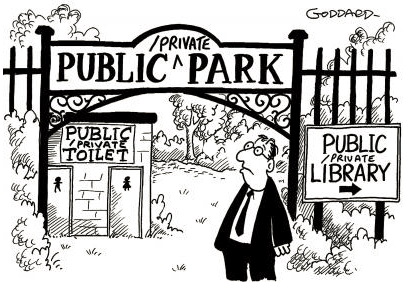
The first thing I want to go over that’s been becoming more common is the concept of “Privately Owned Public Spaces.” These space are what we would recognize as being public, such as plazas, parks, or sidewalks but have been sold through privatization measures to companies and businesses. This is done so that places that should be for public use can to transformed in a way for the owner to profit, or to create a space that is specific to what they want. Thus this is forcing what they want onto others by removing the universal use of public spaces. For example, in places with cafes or restaurants these businesses could buy the public area and remove the seating around them, only allowing paying customers to use the seating in their businesses. In this way companies can transform public spaces into ones that poses no threat to them, and by extension make that public space less useful to people. In another example these “public” spaces can have strict rules, such as no photography, not being allowed to stay for a certain amount of time, and not being able to use the space in a way that does not financially benefit the owner. Since this is a privatized and commercialized mindset anything that isn’t making money is deemed an unnecessary expense, and thus not allowed.
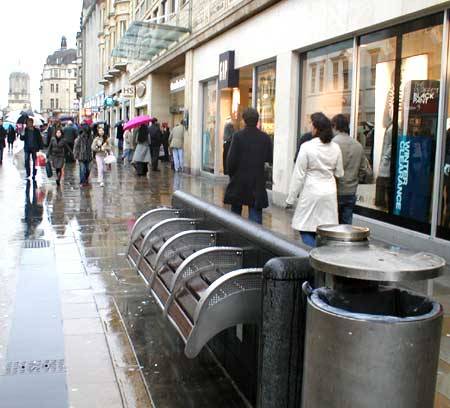
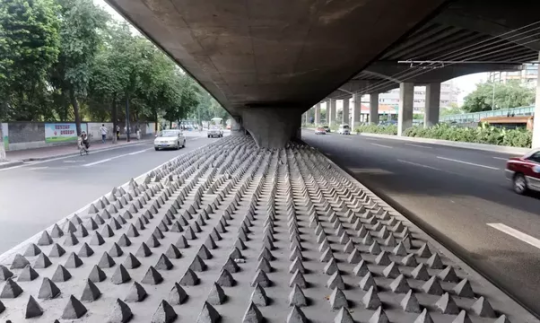
In public spaces that are still being made to be used by the public though, a new idea of what these spaces should be has taken root. This idea is that these spaces should be made for a very specific purpose and otherwise hostile to the user. An example of this is a recent trend to make “benches” that vaguely fulfil the idea that a resting spot should be available, while at the same time strictly enforce the idea that this is a temporary place and you aren’t supposed to stay. This can be seen in objects such as “leaning benches” that just give people a place to lean instead of actually sit, or specifically designing beaches to be uncomfortable by adding spacers or narrow “arm rests” that are too short to be used. All these are methods to make public spaces less a place of gathering and meeting and instead a transitional place that actively discourages long term use.
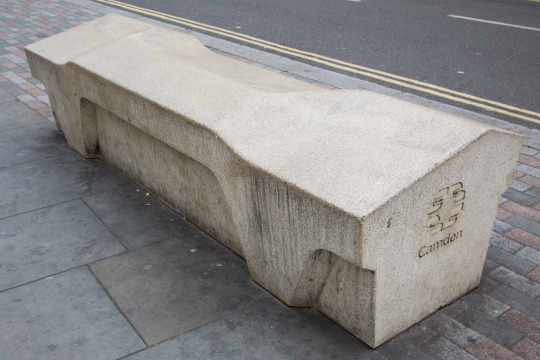
This all ties into the concept that goes by many different names, but can be summarized in the idea of “Hostile Architecture.” This is a design philosophy that seeks to make the design of public spaces hostile to its users, or more specifically to discourage usage that is not approved of by the owner. In this way I think Hostile Architecture goes against the very idea of a public space, IE a space that the public can use in a way they see fit. This idea is embodied in the creation of, and response by, the creators of, the Camden bench. This bench was specifically designed in a way that it was only supposed to be used a certain way, and the creators even try to defend it by saying that “[Because] there is no ‘correct’ way to sit on it… it becomes a far more inclusive seat encouraging social interaction.” This notion that they are somehow being creative and helping people by making an uncomfortable bench that isn’t as good as a normal bench by any measure of the imagination, is a perfect example of how this was specifically created as a hostile object. The creators are trying to redefine something that is explicitly negative as something that is somehow a positive because of the connotations of making something explicitly negative means.
But, one of their other responses is an even better look into how this mentality works, “Homelessness should never be tolerated in any society and if we start designing in to accommodate homeless then we have totally failed as a society.“ This brings up one the major points I have about Hostile Architecture, and that is its function to hide problems in society. By creating hostile public spaces it doesn’t fix crime, drug use, violence, and homelessness like the creators of this stuff would have you believe. Instead all this does is make it so problems are less visible on the surface because it’s not as convenient to do them in public anymore. People don’t just stop being homeless because you design benches they can’t sleep on, or put down spikes so they can’t stay somewhere that’s safe. These are problems with society that can not be fixed by commercializing public spaces at the whims of a profit seeking owner, or by making them unusable by anyone but the “right” kind of person.
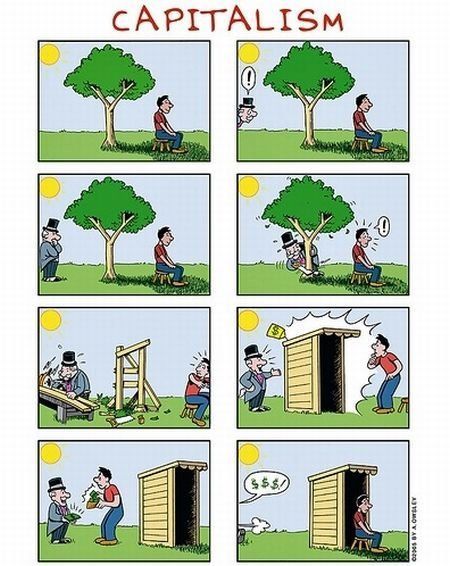
All of this ties back to one central source. Privatization only helps the wealthy that own the land and helps them to create a situation where they get more money. And ignoring these social problems only creates a situation where taxes to fund social help can be cut because the public perception can be that it’s not really a problem. All of this only benefits one group of people, and that is the upper class that control almost all of the money. By removing things people can use for free they are creating a system where they can be relied on more and more, and people are required to pay for what used to be cheap or even free. Once again I will say this, in the capitalist system there is no room for anything that does not directly benefit the people that own and control society. They will continue to sink themselves into any part of society we let them in, and only by understanding these motives and reasonings can there be any resistance against it.
“Capoeira is an Afro-Brazilian martial art developed by African slaves in Brazil, and basically Africans wanted to disguise their martial arts and training as a dance, and I think Capoeira is one of the most beautiful things that has ever been created evolve from oppression.”



















 Thoughtfulfangirling